Science is best understood when it moves beyond textbooks and becomes something students can see, explore and experience. While traditional classroom learning provides the theoretical foundation of science, practical experimentation helps learners understand how scientific concepts work in the real world.
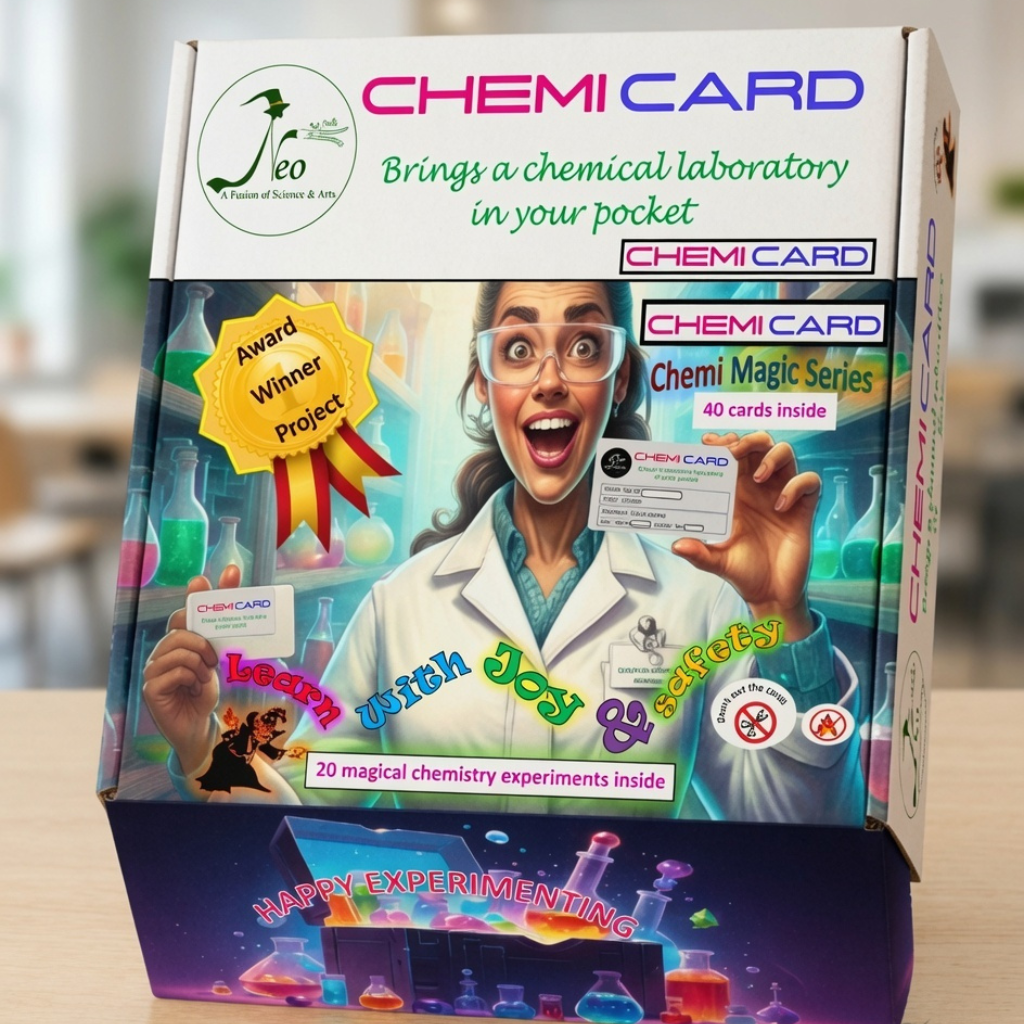
This is where Chemi Card by NeoSci-Tech Knowledge Solution Pvt. Ltd. presents an interesting approach to science education. Developed as a compact “Pocket Laboratory,” Chemi Card is designed to make learning in chemical and biological sciences more interactive, practical and accessible.
From Reading About Science to Experiencing It
A common challenge in science education is the gap between theoretical knowledge and practical experience. Students may learn about chemical reactions, scientific principles and biological concepts from books, but understanding can become much stronger when they have the opportunity to observe scientific processes themselves.
Chemi Card is designed around this idea of experiential learning. Instead of limiting science to diagrams, explanations and memorisation, it aims to give learners an opportunity to engage with experiments in a practical environment.
Its portable format is particularly significant. A laboratory is traditionally associated with a dedicated room, equipment and infrastructure. A pocket laboratory takes a different approach by making experimentation more accessible and easier to integrate into learning environments.
What Makes a Pocket Laboratory Different?
The concept behind Chemi Card is built around three important ideas: portability, practicality and accessibility.
Being portable means that practical learning does not necessarily have to remain confined to a conventional laboratory setup. It can become part of a more flexible educational experience.
Its focus on practical experimentation can also encourage students to approach science with greater curiosity. Rather than simply asking, “What is the answer?”, students can begin asking questions such as:
What happens when two substances interact?
Why does a particular change occur?
What can we observe during an experiment?
How does the observation connect with what we have learned in class?
These questions are at the heart of scientific thinking.
Making Science More Engaging for Students
One of the important objectives of experiential learning is to make students active participants in the learning process.
When students observe a scientific phenomenon directly, they can connect classroom concepts with real observations. This can help turn abstract ideas into experiences that are easier to explore and understand.
According to NeoSci-Tech’s company profile, Chemi Card is intended to develop scientific curiosity and conceptual understanding while enabling students to perform experiments safely. This positions the product not merely as an experiment kit, but as a learning tool designed to support a more interactive approach to science education.
A Tool for Teachers as Well as Students
Practical learning is not beneficial only to students. Teachers also need effective tools that can help demonstrate scientific concepts in an engaging way.
NeoSci-Tech positions Chemi Card as an Effective Teaching & Learning Material (TLM) and identifies schools, colleges and educational institutions among its intended users.
This creates possibilities for Chemi Card to complement classroom teaching. A teacher can introduce a scientific concept theoretically and then use practical experimentation to encourage observation and discussion.
The result can be a learning process that moves through three stages:
Learn → Experiment → Understand
This approach can make the connection between theory and practice more visible.
Science Education That Fits Different Learning Environments
Another notable aspect of Chemi Card is its emphasis on portability and ease of use. Educational institutions can have different levels of laboratory infrastructure, resources and facilities. A compact learning solution can potentially help bring practical experiences into a wider variety of educational settings.
NeoSci-Tech describes the product as suitable for schools, colleges and educational institutions across educational boards and systems. Its company profile also highlights affordability, portability and a broad potential customer base involving students, teachers and institutions.
This reflects a larger idea: practical science education should not feel inaccessible or restricted to highly equipped laboratories.
Encouraging Scientific Curiosity
Perhaps the most important outcome of a product like Chemi Card is not the experiment itself, but the curiosity that the experiment can create.
Science progresses through questions. A student observes something unexpected, asks why it happened, develops a possible explanation and seeks evidence. That process gradually builds scientific thinking.
A practical learning tool can therefore serve as a starting point for exploration.
Instead of simply remembering a scientific fact, students can begin developing the habit of observing, questioning and investigating.
NeoSci-Tech’s Larger Vision
Chemi Card is also part of a broader vision at NeoSci-Tech Knowledge Solution Pvt. Ltd. The company, established in 2025, describes its work as being at the intersection of science, education and creativity, with a focus on developing innovative STEM solutions for natural sciences.
Its R&D-driven approach is aimed at developing STEM products that address existing gaps in science education and create meaningful learning experiences for future generations.
The company’s vision extends beyond STEM education as well. Its profile describes an ambition to bridge Arts and Science, develop creative products and create opportunities for skill development and employment.
This makes Chemi Card one part of a larger ecosystem built around the idea that learning can be both scientific and creative.
The Future of Experiential Science Learning
Education is continually evolving. Students today have access to information faster than ever, but access to information alone does not necessarily create deep understanding.
The ability to experiment, observe and experience can make learning more meaningful.
Products such as Chemi Card represent an interesting direction in STEM education—one where practical experimentation can become more portable, accessible and integrated into the learning process.
A laboratory may traditionally be thought of as a room filled with equipment. Chemi Card introduces a different possibility: what if some of the experience of a laboratory could fit into a compact learning tool?
That is the idea behind the Pocket Laboratory.
And ultimately, its value lies not just in the experiments students perform, but in the questions those experiments encourage them to ask.
Final Thought
The future of science education is not only about teaching students more scientific facts. It is about helping them think like scientists.
By combining portability, practical experimentation and experiential learning, Chemi Card aims to make that process more accessible and engaging.
For NeoSci-Tech, this is part of a larger mission—to inspire scientific thinking, foster creativity and create meaningful opportunities for education, innovation and skill development.